Also available in简体中文Bahasa Melayu
Trending
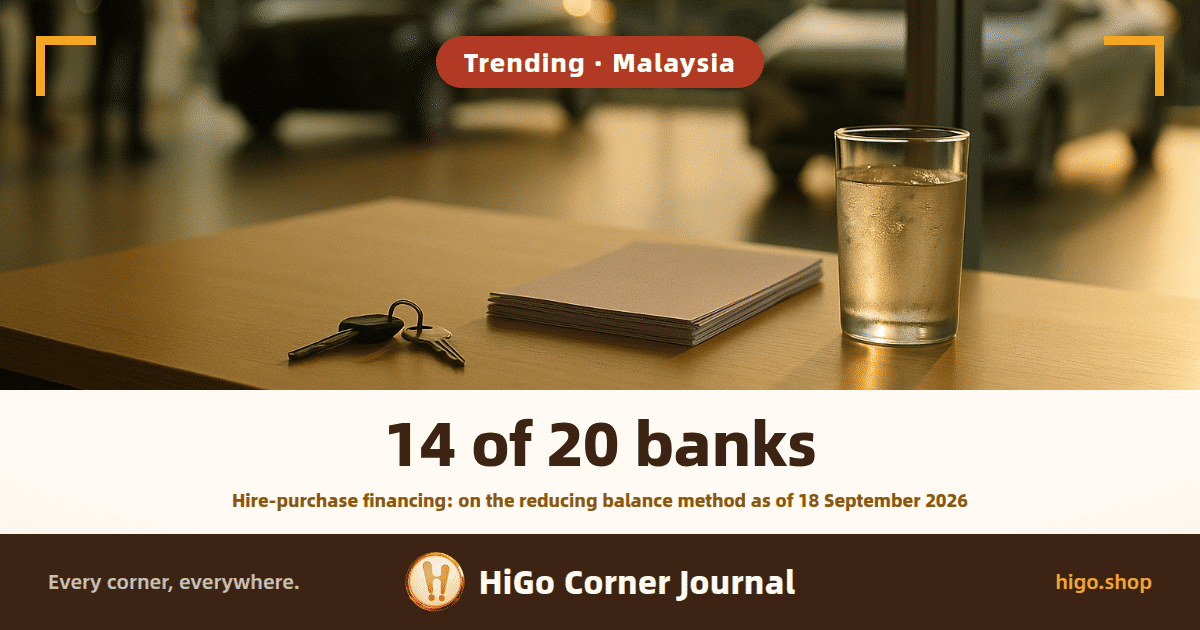
14 of the 20 banks that provide hire-purchase financing in Malaysia had begun offering the reducing balance method: where things stood on 18 September 2026
In Bank Negara Malaysia's own worked example, borrowing RM100,000 over 9 years at a flat rate of 3% p.a. and at an EIR of 5.5% p.a. works out the same either way: RM1,175.93 a month. So when you're shopping for a car loan, don't compare flat rates — ask for the EIR.

The way interest on hire-purchase (sewa beli) financing is worked out changed in 2026 — and for most people, it's buying a car that brings them face to face with it. The minister has now put a number on how many lenders have made the switch, and how many have not.
Domestic Trade and Cost of Living Minister Datuk Armizan Mohd Ali said on 19 September 2026 that of the 20 banking institutions providing hire-purchase financing, 14 had begun offering customers the reducing balance method as of 18 September 2026. Bernama
He said that after engagement sessions with the banks, the remaining 6 are expected to complete the transition by 31 December 2026 at the latest. He was speaking at Batu Kawan Stadium in Penang, at the closing ceremony of the Consumer Festival (CONFEST) 2026, organised by the Ministry of Domestic Trade and Cost of Living (KPDN) from 17–20 September 2026 under the theme “Suara Kita: Kuasa Kita”.

What to look at
- The reducing balance method charges interest on the principal you still owe. Bank Negara Malaysia's consumer guide says interest charges are calculated on the outstanding principal amount, so you can see how much of each monthly instalment goes to interest and how much goes towards the principal. Bank Negara Malaysia's consumer guide
- In force since 1 June 2026, replacing the flat rate and the Rule of 78. The minister said the amendments that took effect on 1 June 2026 brought in the reducing balance method and the effective interest rate (EIR) in place of the flat interest rate and the Rule of 78. In his words, under this method interest is calculated on the current loan balance, which makes early settlement clearer for consumers.
- The Rule of 78 was dropped because it front-loads the interest. The guide says the Rule of 78 frontloads interest payments, so the interest cost is higher early on and the principal still outstanding at early settlement is larger. The guide's example is a 9-year plan in which, right up to the third year, most of each monthly payment goes towards interest rather than reducing the loan.
- Compare EIRs, not flat rates. The guide says the EIR is the actual percentage of interest you pay over the financing tenure, reflecting the interest on your outstanding balance at the time each instalment is paid. A provider may quote a flat rate that looks cheaper, but that does not give you a lower monthly instalment.
- The rate ceiling is now written as an EIR. For fixed rate financing, the guide says, the old ceiling of a flat rate of 10% p.a. has been replaced by the corresponding EIR for each tenure band: the EIR is capped at 17% p.a. for tenures of up to 5 years and 16% p.a. for tenures of more than 5 years. For variable rate financing, the existing ceiling stays: an EIR of 17% p.a.
- 429 entities are registered with the trade body. The minister said there are 429 entities in total, banking institutions and hire-purchase providers, registered with the Association of Hire Purchase Companies Malaysia (AHPCM). He added that the ministry had set a target of 80% of hire-purchase providers offering financing that complies with the Hire-Purchase (Amendment) Act 2026 by the end of 2026. That is the target, not something already achieved.
RM100,000 over 9 years, as the regulator works it out
Bank Negara Malaysia's guide sets up an example: you borrow RM100,000 over 9 years, or 108 months. Three hypothetical banks quote it three ways.
- Bank A: a flat rate of 3% p.a. Monthly instalment RM1,175.93, total interest RM27,000.
- Bank B: an EIR of 5.5% p.a. Monthly instalment RM1,175.93, total interest RM27,000.
- Bank C: an EIR of 5% p.a. Monthly instalment RM1,151.76, total interest RM24,390.
The guide's conclusion: Bank A and Bank B leave you with the same instalment and the same total interest, because over a 9-year tenure an EIR of 5.5% p.a. is equivalent to a flat rate of 3% p.a. Go with Bank C on the same RM100,000 over 9 years and you pay RM24.17 less a month and RM2,610 less in interest across the nine years. The guide notes under the table that this equivalence changes with the loan tenure.
Which is why the guide puts it this way: the flat rate may look cheaper at first glance, but it does not reflect the true cost of the financing you're taking on; to avoid surprises and to compare accurately, always ask the provider for the EIR.

The questions readers ask most
- Will the agreement I signed before 1 June 2026 switch over by itself? No. The guide says changes to the existing provisions under the Hire-Purchase Act 1967 apply only to new agreements secured after the Hire-Purchase (Amendment) Act 2026 takes effect, and that agreements already signed under the Hire-Purchase Act 1967 continue to follow their original contractual terms and conditions. The guide then gives the other half of the picture: the Hire-Purchase (Amendment) Act 2026 gives you and your provider the flexibility to mutually agree to elect the method of calculating the net balance due under the agreement in line with the new Act — subject to the provider being ready to do the sums that way.
- Settling an older agreement early: what do you get? The joint media statement of 16 March 2026 by three associations (ABM, AIBIM and ADFIM) says that from 1 June 2026, banks will provide goodwill discounts to eligible customers who opt to settle their existing fixed rate hire-purchase financing early where it applies the Rule of 78. With the discount, the statement says, the outstanding balance at early settlement is more comparable with what it would have been under the reducing balance method. No amount is published: each bank works out the discount based on the terms of the customer's own agreement, including the tenure and when the early settlement is made, and the exact discount and details are given to the customer at the point they request early settlement. Joint media statement
- Who does not qualify for the goodwill discount? The same statement says it applies to individuals and micro and small businesses holding fixed rate hire-purchase agreements that use the Rule of 78, entered into before 1 June 2026 or during the transition period ending 31 March 2027, where the customer chooses to settle before maturity. When you apply, the account must not be in arrears exceeding 90 days, must not be under legal action or issued with a repossession order, and must not be under an existing restructuring and rescheduling (R&R) or enrolled in a formal debt management programme.
- Why is there no rebate on early settlement under a new agreement? The guide says providers will no longer offer rebates at the point of early settlement to customers who contracted under the new provisions of the Hire-Purchase (Amendment) Act 2026, and explains why in the same passage: both fixed rate and variable rate loans adopt the reducing balance method, interest is calculated on the customer's outstanding principal balance, and once the customer pays off that balance no further interest accrues — so the need for such a waiver or rebate does not arise.
- Can banks still write new loans on the Rule of 78 during the transition? Yes. The joint statement says KPDN has confirmed that the amended Act takes effect on 1 June 2026, with a transition period until 31 March 2027 for banks to make the necessary systems, process and infrastructure enhancements, and that during this period banks may continue to provide new hire-purchase financing under the Rule of 78 while they update. The minister said on 19 September 2026 that providers not yet fully prepared have a grace period until 31 March 2027, with full compliance required from 1 April 2027.
- Fixed rate or variable rate: what is the difference? The guide says a fixed rate stays the same for the entire financing period, so your instalments don't change and it's easier to plan the household budget, while a variable rate can move up or down with the Overnight Policy Rate (OPR), taking the instalment with it. It also notes that as at December 2024, variable rate hire-purchase financing accounted for 15% of the hire-purchase offerings by banks.
The list from March, and the number from September
The Association of Banks in Malaysia (ABM) hosts a table dated 17 March 2026, titled “Summary of banks' readiness to adopt the reducing balance method”, setting out when each of 20 banks intended to move to it. In the fixed rate column, 12 were listed as ready by September 2026: MBSB Bank by June 2026, Bank Rakyat by August 2026, and another 10 by September 2026 — Ambank, Ambank Islamic, CIMB Bank, CIMB Islamic Bank, Hong Leong Bank, Hong Leong Islamic Bank, Maybank, Maybank Islamic, Public Bank and Public Islamic Bank.
After that came 5 by December 2026 (Affin Bank, Affin Islamic Bank, Bank Muamalat, RHB Bank, RHB Islamic Bank), 2 by January 2027 (Bank Islam, Bank Simpanan Nasional) and 1 by April 2027 (Agrobank). The floating rate column is counted separately: on that table of 17 March 2026, 9 were marked as already offering it.
That table and the minister's number are not the same thing. The March table is what the banks themselves planned; the minister was describing the position as of 18 September 2026. The two numbers come from two different documents and count two different things, the authorities have never put the two side by side, and neither the 14 nor the remaining 6 have been named. For your own bank, the answer that counts is the one it gives you.
Where to ask, and what to ask
- Open with this: “What's the EIR?” The guide's tip is to shop around and compare the EIR offered by several hire-purchase providers before accepting any offer. The three associations suggest the same thing: ask the banks whether they offer the new reducing balance method during the transition period, and use the EIR to compare options across banks.
- Then ask: “Have you switched to the new method?” The guide flags this as the most important one — remember to ask the hire-purchase company whether they have already switched.
- The list sits on the associations' websites. The three associations say a list of banks ready to offer the reducing balance method during the transition period is published on the websites of all three, ABM, AIBIM and ADFIM; the one on ABM's site is dated 17 March 2026.
- Budget for more than the instalment. The guide says you need to set aside money not just for the 10% down payment upfront, but for the instalments across the whole tenure, plus related costs like insurance or takaful, road tax and vehicle maintenance.
- If something goes wrong. The guide says to take the complaint to your hire-purchase provider first, and to escalate only if you are not satisfied with its final response. Where the provider is regulated by Bank Negara Malaysia, you may escalate to the Financial Markets Ombudsman Service (FMOS) or BNMLINK. You may also lodge a complaint with the Ministry of Domestic Trade and Cost of Living — through KPDN's e-complaint portal, the toll-free number 1-800-886-800, email e-aduan@kpdn.gov.my, or by writing in to or walking in to the nearest KPDN office.
Before you sign
- If your agreement was signed before 1 June 2026, it keeps its original terms; moving it to the reducing balance method takes a mutual agreement between you and the bank, and depends on the bank's systems being ready.
- If you are about to sign a new hire-purchase agreement, ask what the EIR is, then ask whether that lender has moved to the reducing balance method — as of 18 September 2026, 14 of the 20 banking institutions were offering it.
- If you plan to settle an older Rule of 78 agreement early, check first that the account is not in arrears exceeding 90 days, not under legal action or a repossession order, and not under an existing restructuring and rescheduling (R&R) or a formal debt management programme, then apply; you'll only be given the actual figure when you ask for it.
From the corner, to the world.