Also available in简体中文Bahasa Melayu
Trending
MyKad replacement in Malaysia costs RM10 to RM1,010: the new version opens on 17 September 2026 and the minister says don't rush
JPN's site carries only its current replacement fees, checked on 16 September 2026: a damaged card, a lost one, a change of address and a change of details each work out differently, and a loss on its own splits into three bands. Whether swapping a perfectly good card for the new version costs anything isn't on the site.

Applications for the new MyKad open from 17 September 2026, but there's no need to rush down and swap. That was the Home Minister, Datuk Seri Saifuddin Nasution Ismail, speaking to reporters on 15 September 2026. It was not a JPN announcement.
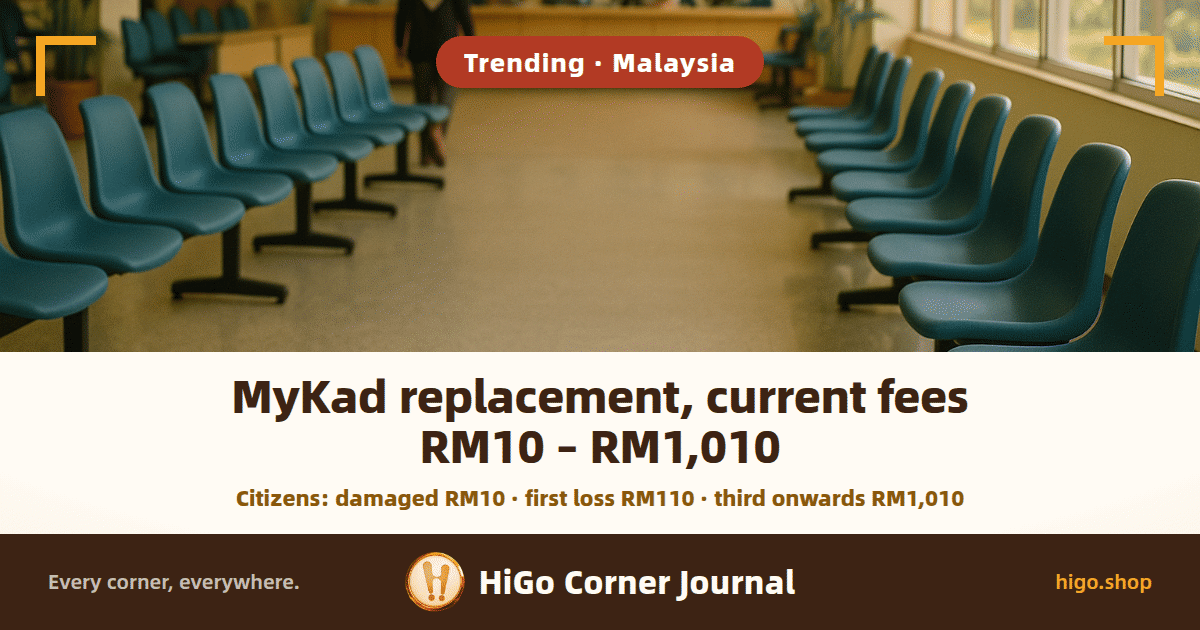
JPN's own pages put the cost for citizens at RM10 to RM1,010: RM10 if the card is damaged, RM110 for a first loss, RM310 for a second and RM1,010 for a third or subsequent one. JPN: damaged card replacement · JPN: lost card replacement
So before you decide whether 17 September 2026 is worth a trip, settle two things: which kind of replacement you actually need and what it costs, and which offices can print the card while you wait. What the new card looks like, and what it adds, is a separate question. No official page describes it, only the press does, and that comes further down.
What stands out
- Applications open from 17 September 2026, and the existing MyKad stays valid. The Home Minister told reporters on 15 September 2026 that the new MyKad is being rolled out in phases and that the card in your wallet still works for everyday dealings. Bernama, 15 September
- Why he says don't rush: the sheer numbers. On 15 September the minister said 24 million MyKads have been issued nationwide, and that JPN currently issues an average of 180,000 to 200,000 cards a month.
- JPN hasn't published which offices take the first applications. The list of 58 offices that is on its site answers a different question. See “Where to go” below.
- If you do need a card, the expensive band is losing it. On JPN's fee tables a damaged card costs citizens RM10, a first loss RM110 and a third or subsequent loss RM1,010. Both bands include the same RM10 application fee. What jumps is the processing fee, from RM100 to RM1,000.
- JPN's site lists 58 offices that print cards on the spot. Which states they are in, and how many Kuala Lumpur and Selangor have between them, is in “Where to go” below.
What a MyKad replacement costs
First, what these figures are. They are JPN's current replacement fees, for a card that is damaged or lost, or for a change of address or details. Whether swapping a perfectly good card for the new version costs anything, and how much, was not on JPN's site as of 16 September 2026. All the fees below come from JPN's service pages, checked on 16 September 2026, under the National Registration Regulations 1990 (amended 2007):
- Damaged card: RM10 for citizens, RM40 for non-citizens. If you apply for another damaged-card replacement within 12 months of the date you handed the damaged card in, JPN's page says it is free of charge. The word on the page is PERCUMA. JPN: damaged card replacement
- Lost card: RM110 for a first loss, RM310 for a second, RM1,010 for a third or subsequent one. Broken down, that's an application fee of RM10 plus a processing fee of RM100, RM300 or RM1,000. For non-citizens (MyPR or MyKAS) the three bands are RM140, RM340 and RM1,040. JPN: lost card replacement
- Change of address: RM10 for citizens, RM40 for non-citizens, charged only when a new card has to be issued. If you move somewhere you'll live for 90 days or more, the address on the card has to change. You have to come in person, and the address has to be a fixed residential one in Malaysia, so a workplace, an office or a PO Box won't do. Anyone under 18 needs a parent or guardian along. JPN: change of address
- Change of details: RM20 in total for citizens. A processing fee of RM10, then a replacement fee of RM10 once the application is approved (RM40 for non-citizens). Form JPN.KP16, in person at the counter. JPN: change of details
- A 12-year-old's first card: nothing to pay within 30 days of the birthday. If it is left later than that, there's a processing fee of RM10, the same figure right up to age 16. Form JPN.KP01, with a parent along, or a grandparent, aunt, uncle or older sibling over 21. JPN: MyKad for 12-year-olds
Two refund rules. Both the damaged-card page and the lost-card page say nothing is refunded once the Bahagian Kad Pengenalan, JPN's identity card division, has processed the application. The lost-card page carries one more: nothing is refunded even if the old card turns up later.
Questions readers ask
- Do I have to make a police report first? It depends on how the card went missing. JPN's page says a police report is required from the first loss onwards where the card was lost through a crime, and is compulsory from the second loss onwards where it was lost through carelessness.
- Does a damaged-card replacement have to be done at the counter? The same page gives two different answers. Under Syarat (conditions) it lists any JPN counter, the Sistem Gantian MyKad on the JPN website, or a phone-in line on 03-8880 8066. The last two are only for citizens, and only where the application doesn't involve changing the photograph or the details. Under Prosedur (procedure), you have to turn up at a JPN counter with the original documents. Online payment is by credit card only.
- Will switching to the new MyKad break my subsidies or the dealings tied to my card? The Home Minister said on 15 September 2026 that it won't: subsidy eligibility and the dealings linked to the identity document aren't affected, and your records stay with the existing MyKad. That's the minister speaking, not something on JPN's site. Bernama, 15 September
- What do I bring for a change of address? JPN's page lists an electricity, water, sewerage or other utility bill, assessment rates, assessment tax, an income tax assessment form, a house sale and purchase agreement, or a tenancy agreement or rent receipt, or similar documents. Originals or certified copies both count.
- Can I skip changing the address after moving? No. JPN's page is plain about the basis: regulation 15 of the National Registration Regulations 1990, once you move somewhere you'll live for 90 days or more.
What the minister said, and what only the press has
As of 16 September 2026 JPN's own website carried no announcement about the new MyKad, neither in the announcements list nor in the media centre, in either the Malay or the English version. So these claims come in two grades:
- From the minister. The Home Minister told reporters on 15 September 2026 that applications for the new MyKad open from 17 September; that the changeover runs in phases and the existing MyKad stays valid; that the new version carries about 50 more security features than the old one; and that switching doesn't affect subsidy eligibility or the dealings tied to the identity document. That is how Bernama's Malay report has it. Bernama, 15 September
- From the press only. The technology site SoyaCincau reported on 16 September 2026 that the new card has 53 security features. It describes a polycarbonate body, a dynamic hologram with three-dimensional effects, ultraviolet elements, guilloche patterns, a transparent window and a QR code, with a dual-interface contact and NFC chip and no Touch 'n Go function. The same piece says that initially 40 selected JPN and UTC offices with card-printing facilities will be able to hand the card over the same day, and that branches without printing facilities will take around five working days. Those lines are from that report, not from an official page. SoyaCincau, 16 September
- The two counts of security features don't match, so both are here as written. SoyaCincau's 53 on 16 September is a total. The minister's about 50 on 15 September is what the new version adds to the old one. They may not be describing the same thing.
Where to go
- JPN's list is called Pusat Cetakan Teragih, the distributed card-printing centres: 58 offices, cards printed on the spot. That is 35 state and branch JPN offices plus 23 UTC branches. It answers which offices can print a card while you wait, not which offices take the first new-MyKad applications. That second list hasn't been published. JPN office list
- How the 35 JPN offices break down: Sabah 5, Sarawak 5, Johor 4, Selangor 3, Perak 3, Kelantan 3, Pahang 3, Penang 2, Kedah 2, Terengganu 2, the federal territories 2, Melaka 1.
- How the 23 UTC branches break down: 16 in the peninsula, 4 across Sabah and Labuan, 3 in Sarawak.
- Eight between Kuala Lumpur and Selangor. Kuala Lumpur, a federal territory rather than a state, has 4: JPN WP Kuala Lumpur, plus the UTC branches at UTC Kuala Lumpur, UTC Sentul and UTC Keramat. Selangor has 4: JPN Shah Alam, JPN Petaling Jaya and JPN Klang, plus UTC Selangor.
- Johor, Sabah and Sarawak. Johor has 4 JPN offices on the list, plus 2 UTC branches. Sabah and Sarawak have 5 JPN offices each. In the UTC column they are grouped differently: 4 for Sabah and Labuan together, 3 for Sarawak.
- Call first. The list page itself says offices and the facilities they provide can change from time to time, and advises the public to contact the JPN office concerned before turning up.
Before you set off
- If your old MyKad is in good shape and you haven't moved or changed any details, nothing about 17 September 2026 requires you to be at a counter. The minister said on 15 September that the old card stays valid, and as of 16 September 2026 JPN's site doesn't say whether swapping for the new version costs anything.
- If you have already had one damaged card replaced this year, count from the day you handed that old card in. Within 12 months another damaged-card replacement is free of charge on JPN's own page. After 12 months it is RM10 for citizens.
- If you want to walk out with the card, pick from JPN's list of 58 offices first, then follow the page's own advice and call that office.
Every corner, everywhere.